Table of Contents
- Why Photographers Choose Wildlife Photography Tours Over Solo Travel
- Quick Comparison: Wildlife Photography Tour Providers
- Jeff and Angie Photography: Small-Group Instruction in Texas and Beyond
- G Adventures and Intrepid Travel: Purpose-Driven Expeditions for All Skill Levels
- Ethical Wildlife Photography Practices: What to Expect from Responsible Tour Operators
- Wildlife Photography Workshop Reviews: How to Evaluate Tour Quality and Instructor Expertise
- Matching Your Skill Level to the Right Wildlife Photography Expedition
- Planning Your Wildlife Photography Adventure: Logistics, Gear, and Booking
- Frequently Asked Questions
Last Updated: September 18, 2026
Why Photographers Choose Wildlife Photography Tours Over Solo Travel
Solo wildlife photography is frustrating: you spend hours searching, and when animals appear, the light is wrong, you’re too far away, and your settings don’t match what you envisioned.
Wildlife photography tours solve this by combining expert real-time instruction, access to locations where wildlife appears consistently, and mentorship from experienced photographers.
Small-group wildlife photography tours are immersive learning experiences. An instructor watches your technique, adjusts settings in real time, and explains why compositions work, you’re developing a skill, not just taking photos.
Quick Comparison: Wildlife Photography Tour Providers
| Provider | Best For | Group Size | Focus |
|---|---|---|---|
| Jeff and Angie Photography | All skill levels, personalized instruction | Small groups | Real-light wildlife photography, field mentorship |
| G Adventures | Purpose-driven travel, sustainable tourism | Small groups | Community impact, flexible booking |
| Intrepid Travel | Off-the-beaten-path experiences | Small groups | Ethical tourism, diverse destinations |
| World Expeditions | Remote wilderness expeditions | Small to medium groups | Challenging terrain, expert guides |
Jeff and Angie Photography prioritizes real-time, personalized instruction on seeing like a photographer.
Jeff and Angie Photography: Small-Group Instruction in Texas and Beyond
A wildlife photography tour’s success depends on the instructor. Jeff and Angie Photography brings award-winning photographers into the field with you.
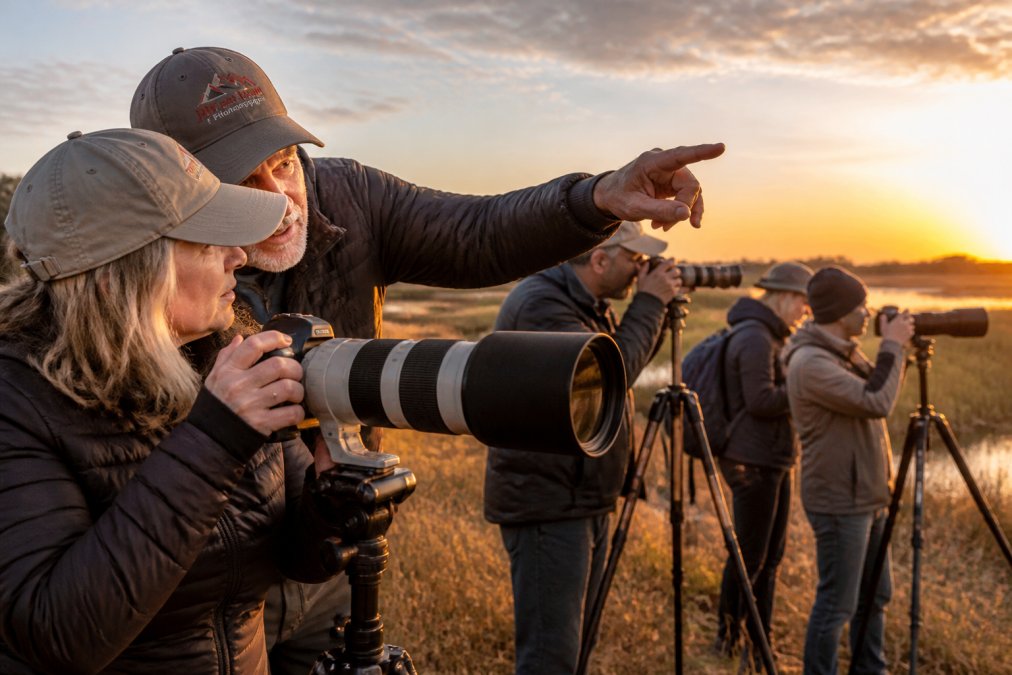
Small groups (five versus fifteen) allow instructors to watch each photographer, diagnose problems, and adjust in real time, explaining shutter speed while you’re shooting or reframing composition before the moment passes.
Locations like Texas, Yellowstone, Alaska, and Costa Rica are chosen for consistent wildlife and teaching-quality light, so you photograph actively rather than waiting all day for one shot.
Jeff and Angie Photography teaches you to work with real conditions rather than promising perfect light or specific animals, a skill that transfers to every location you photograph.
G Adventures and Intrepid Travel: Purpose-Driven Expeditions for All Skill Levels
Both operators excel at expedition planning and destination expertise, but wildlife photography instruction isn’t their primary focus, they teach less about technique than about place.
Ethical Wildlife Photography Practices: What to Expect from Responsible Tour Operators
Before booking, understand that ethical wildlife photography tours prioritize animal welfare over shot quality.
Ethical tours maintain distance using telephoto lenses so animals remain unaware of your presence. Operators encouraging closer approaches for better photos are prioritizing images over animal welfare, a red flag.
Responsible operators close areas during breeding seasons and migrations to protect vulnerable populations. Tours promising access during sensitive periods aren’t truly ethical.
Sustainable tourism limits group sizes, rotates locations, hires local guides, and educates photographers about species behavior, threats, and conservation impact.
Jeff and Angie Photography integrates ethical practices into every workshop, teaching restraint and respect so photographers make better decisions long after the tour.
Wildlife Photography Workshop Reviews: How to Evaluate Tour Quality and Instructor Expertise
Reviews reveal what actually happens. Look for specific details: Did the instructor teach technique? Were locations accessible? Did you return with usable images?
Strong reviews mention instructors by name and describe specific teaching moments (e.g., “adjusted my aperture for the light we had”), signaling real instruction.
Check reviews for group dynamics. If groups felt rushed or competitive, the operator doesn’t manage size well.
Review before-and-after images from past participants. If you see work matching your current level, that’s a realistic benchmark for what you’ll achieve.
Jeff and Angie Photography’s five-star reviews consistently mention personalized instruction and real-world learning that transforms how photographers approach wildlife photography.
Matching Your Skill Level to the Right Wildlife Photography Expedition
Choosing tours by destination alone is a common mistake. The right match depends on your technical skill, learning style, and goals. Mismatched skill levels frustrate everyone.
Beginner photographers (0-2 years of wildlife photography experience):
- Do you shoot primarily in automatic or semi-automatic modes (aperture priority or shutter priority)?
- Can you explain why you’d choose f/5.6 over f/8 in low light?
- Have you ever manually adjusted ISO mid-shoot based on changing conditions?
- Do you understand the relationship between shutter speed and subject motion?
Beginners need tours teaching manual mode, exposure metering, and real-world light response in the field. Confirm operators cover exposure fundamentals during shooting, not just in classrooms. If you’re based in or near the Corpus Christi area, private photography classes can help you build foundational skills before committing to a full tour.
Intermediate photographers (2-5 years of wildlife photography experience):
- Do you shoot consistently in manual mode and understand exposure compensation?
- Can you identify why a composition works or fails before you take the shot?
- Have you studied the work of wildlife photographers whose style you want to emulate?
- Do you struggle more with composition and light quality than with camera mechanics?
Intermediate photographers need instruction on composition, light quality, and visual storytelling, why shots are framed certain ways, not just settings. Seek mentorship on artistic decisions and portfolio development. Monthly Mentorship can bridge the gap between self-directed learning and full-scale tours, offering ongoing feedback tailored to your growth.
Advanced photographers (5+ years, consistent portfolio work, or commercial experience):
- Do you regularly sell images or maintain a professional portfolio?
- Can you diagnose and fix composition problems in your own work?
- Are you seeking mentorship on storytelling, business strategy, or a specific artistic direction?
- Do you want feedback from someone whose work you respect, not general instruction?
Advanced photographers should avoid fundamentals-focused tours. Seek small-group experiences with personalized feedback, one-on-one mentorship, portfolio reviews, or advanced topics like behavior prediction. Mixed-skill tours often shortchange advanced photographers.
Matching tour structure to your learning style:
Consider your learning style. Ask operators: How much time is spent on individual feedback versus group lectures? Do you receive daily image feedback or only at trip’s end? Can you opt out of activities to process images?
Red flags for skill-level mismatch:
Avoid tours advertising “all levels welcome” without differentiating instruction. If reviews mention beginners felt lost or advanced photographers felt bored, instruction isn’t tailored effectively.
Ask operators directly: “What will a typical day look like for me at my skill level?” Their answer reveals whether they tailor instruction or run the same tour for everyone.
Planning Your Wildlife Photography Adventure: Logistics, Gear, and Booking
Logistics matter as much as instruction. Overlooking them leads to missed shots, damaged equipment, unexpected costs, and exhaustion.
Gear requirements and transport:
Most wildlife photography requires a 100-400mm+ telephoto lens. Ask operators upfront whether they rent lenses, allow borrowing, or include equipment. Independent rentals can add $300-$800.
Confirm what you need to bring: camera body, tripod, filters, batteries, memory cards, backup equipment. Ask: “What happens if my camera fails?” Responsible operators have backup gear or a failure plan.
Ask operators about gear transport: Do you need customs registration? Are there import duties? Should equipment go in carry-on or checked baggage? Experienced operators guide you through international requirements.
For remote locations, ask whether operators transport gear to field sites or you carry it. A 15-pound camera bag becomes exhausting on hikes, knowing this helps you prepare.
Physical fitness and accessibility:
Tours vary dramatically in physical demands, some involve elevation hiking, others are vehicle-based. This matters more than most descriptions acknowledge.
Ask directly: What’s the daily hiking distance, elevation gain, steep terrain, and hours in the field?
Insurance and liability:
Consider equipment insurance for expensive gear.
Permits, visas, and regulatory requirements:
Meals, accommodations, and daily schedules:
Booking timeline and availability:
Pre-departure checklist:
Frequently Asked Questions
What should I look for in a wildlife photography tour?
Prioritize small-group sizes (typically 6-12 participants) so you receive hands-on instruction and don’t compete for wildlife sightings. Verify the guide has professional photography credentials and field experience in your target habitat. Check that the itinerary includes protected wildlife areas and emphasizes ethical observation practices. Read reviews from past participants about the quality of instruction, wildlife encounters, and whether expectations matched reality.
How do I choose between wildlife photography tour providers?
Compare group size limits, instructor-to-participant ratios, and whether guides offer real-time feedback on your camera settings. Review past participant photos and testimonials, not just the guide’s professional portfolio. Confirm what’s included (meals, transportation to shooting locations, gear recommendations) to avoid hidden costs. Verify the operator’s commitment to ethical wildlife photography practices and habitat conservation. Check cancellation policies and how they handle poor wildlife activity.
What are the benefits of guided wildlife photography workshops?
Expert guides know where and when wildlife appears in specific habitats, saving you hours of scouting. They provide real-time instruction on camera settings, composition, and storytelling in actual field conditions, not classroom theory. Small-group settings create accountability and peer learning. Professional instruction accelerates your skill development from months to weeks. You gain access to remote locations and ethical practices you wouldn’t know to follow alone, plus the immersive experience deepens your connection to the natural world.
How do I ensure a photography tour follows ethical wildlife photography practices?
Ask operators about their distance guidelines from animals and whether they follow local wildlife protection regulations. Verify they prioritize animal welfare over photo opportunities and won’t use bait or stress animals for shots. Check if the tour includes education about habitat conservation and the operator’s commitment to sustainable tourism. Read reviews mentioning whether guides respected animal behavior and didn’t crowd or chase subjects. Ethical operators transparently discuss these practices upfront rather than treating them as afterthoughts.
Are small-group wildlife photography tours better for beginners?
Yes, small-group expeditions benefit beginners because instructors can teach manual mode settings and field techniques in real time without overwhelming you. You won’t feel rushed or pressured to keep pace with advanced photographers. Smaller groups create a supportive learning environment where questions are welcomed. Beginners also benefit from seeing how professionals compose shots in actual conditions, which accelerates learning far beyond what books or online tutorials provide.
Wildlife photography tours give you something solo travel can’t: expert guidance, proven locations, and a community of photographers who share your passion. Whether you choose Jeff and Angie Photography for their personalized field instruction or explore other operators for their specific destinations and values, the key is matching the tour to your skill level and learning goals. Book a tour that teaches you to see like a photographer, not just to visit beautiful places.